
In summary
A jersey number has one job: to be read quickly from far away. That comes down to size, contrast and a plain font, in that order. Everything decorative comes after.
- For a back number, aim for 30 to 35 cm tall (at least 25 cm) with a stroke of 3 to 5 cm. The WFDF rules minimum is 16 cm.
- Use a single color with a contrast ratio of at least 6:1 against the jersey behind it.
- Pick a heavy, simple font where 1 and 7, and 6, 8 and 9, can’t be confused.
- Keep a calm, high-contrast zone behind the number, especially on all-over sublimated designs.
Numbers are the least glamorous part of a jersey design and the part that fails most often. A beautiful all-over pattern can turn a number into a blur from ten meters away. This guide gives you concrete sizes and contrast figures, so the number works in every game and every photo.
Why jersey number design matters
In ultimate, numbers get used more than people notice. Teammates call for the disc, stat keepers log goals and assists, and commentators and photographers identify players by it.
For most club and rec teams, the reason is simpler. You want to recognize your teammates on a crowded tournament field and find yourself in the photos afterwards. A readable number does both.
So treat the number as a functional part of the jersey, planned first, not a detail added at the end.
Jersey number size
Size is the easiest thing to get right and the one most often shrunk to make room for artwork. Bigger is almost always better for the back number.
The figures below come from the two WFDF documents most teams borrow from. They are a useful benchmark even if your league never checks.
| Element | Recommended | Minimum |
|---|---|---|
| Back number height | 30 to 35 cm | 25 cm (event guidelines), 16 cm (rules) |
| Back number stroke width | 3 to 5 cm | 3 cm |
| Front number height | 10 to 15 cm | optional |
| Name above the back number | 5 to 7 cm tall, at least 4 cm above the number | optional |
Sources: WFDF Uniform Guidelines and the WFDF Rules of Ultimate appendix, section C.
Sizes need a little care across a roster. A 35 cm number fits on a large jersey but can crowd an XXS. When you brief the design, ask for one number size that works on the smallest size you are ordering, and check the proof on both ends of the size chart.
Number contrast
Contrast is what makes a number readable, far more than its color. A red number on a dark blue jersey looks bold on screen and nearly disappears on the field, because both colors have similar brightness.
As a benchmark, the WFDF rules ask for a contrast ratio of at least 6:1 between the number and the jersey color behind it. You don’t need to guess. Put your two hex codes into a free tool such as the WebAIM contrast checker and it gives you the ratio in seconds.
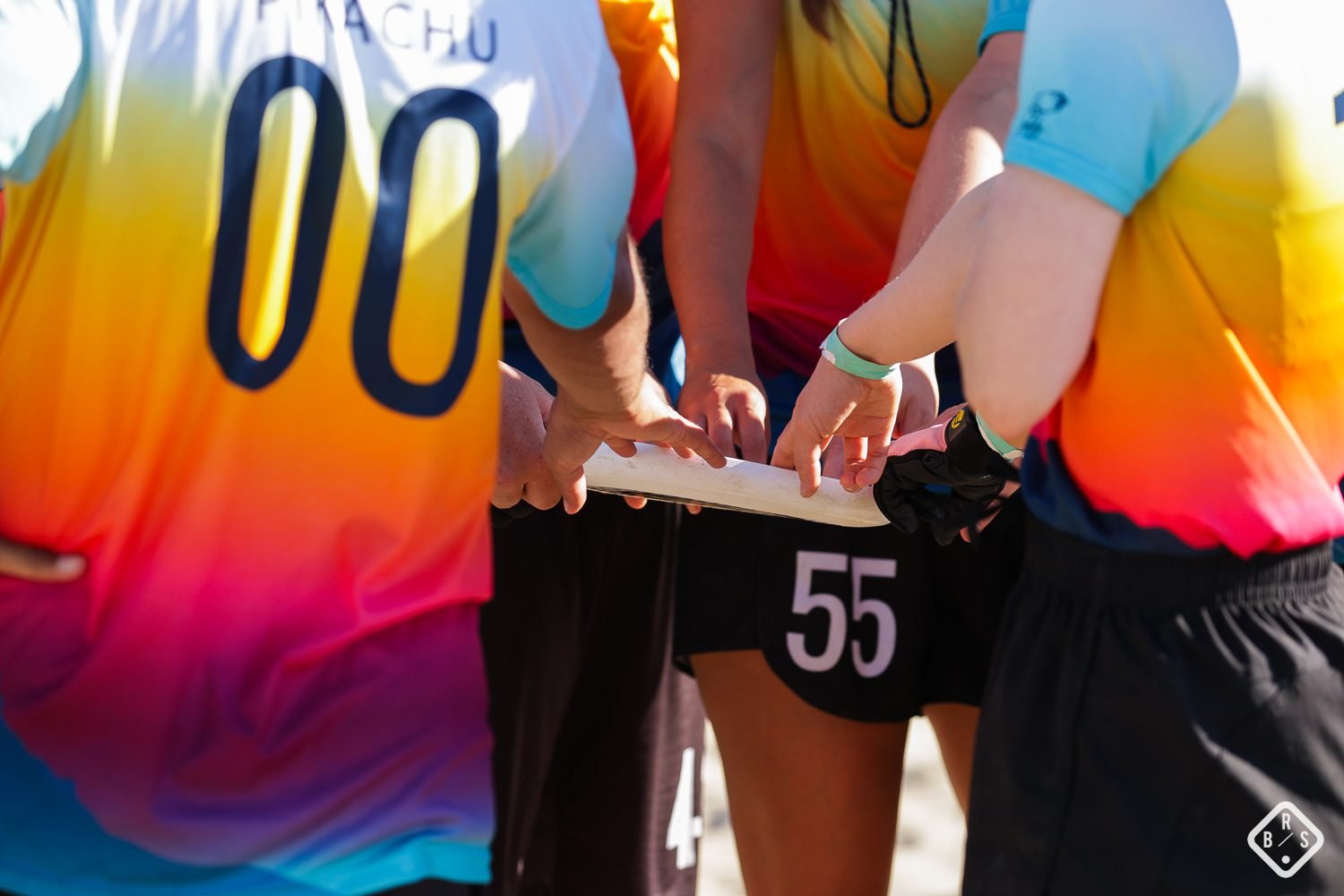
The jersey in the photo gets this right. The dark navy number sits on the light top half of the gradient, where contrast is strongest. The same number on the pink and purple lower half would be much harder to read, which is why the number zone should be planned before the pattern.
Gradients and busy patterns
All-over sublimated designs make contrast harder because the background changes. Check the number against the lightest and the darkest part of the artwork it sits on. If it fails on either, calm the pattern behind the number or add a solid outline.
Light and dark sets
Check the numbers on both jerseys separately. A white number that is perfect on the dark set won’t work on the light one. Our guide to choosing team colors covers color vision and lightness in more detail.
Not sure your numbers will read?
Send us the design and your hex codes and we’ll check the contrast before the proof.
Choosing a jersey number font
The right number font is heavy, plain and consistent. Decorative fonts are fun in a logo and hard to read at speed.
- Choose a bold, even stroke.Thin parts of a character vanish at distance. A block or athletic-style font with a thick, even stroke holds up best.
- Test the confusable digits.Put 1 and 7, 3 and 8, and 6, 8 and 9 side by side. If any pair looks similar at a glance, pick another font.
- Keep two-digit numbers tight.Space between digits should be small and even, so 11 reads as one number, not two ones.
- Avoid effects inside the number.Gradients, textures or photos inside the digits reduce contrast. Use one solid color, with an outline if the background needs it.
If your club has a custom font for its name, it can still work for the name bar. Keep the number itself plain.
Number and name placement
The back number sits centered between the shoulder blades, below any name. That is where it stays flat and visible while a player runs or reaches for the disc.
A front number is optional in most leagues. If you use one, place it on the chest where it won’t fold under the arms, at 10 to 15 cm. A player name goes above the back number, not below it, so it doesn’t get hidden by shorts or a bent back.
Keep numbers away from seams. On sublimated kit the fabric panels are printed before they are sewn, so a number crossing a seam can shift slightly and look broken. Our custom jersey design guide covers templates and seams in more detail.
Ultimate frisbee jersey number rules
Most rec leagues and hat tournaments don’t check numbers at all. Sanctioned WFDF events do, and many national leagues use the same rules as their base. If you might play in one, it is worth designing to them from the start.
The WFDF Rules of Ultimate appendix sets these requirements for numbers:
- Every player on a team has a unique whole number from 0 to 99.
- The back number is at least 16 cm tall with a line width of at least 3 cm.
- The number is a single color with a contrast ratio of at least 6:1 against the shirt.
- Teams bring two distinct shirt sets to each game, with the difference visible to people with color vision deficiency.
The WFDF Uniform Guidelines are what large WFDF events ask of teams. They recommend back numbers of 30 to 35 cm and at least 25 cm. That is why the two documents give different minimums. The first is the rule, the second is the standard for big events.
For a full overview of what a team needs to wear, see our guide to ultimate frisbee uniforms.
Jersey number checklist
Before you approve the proof, go through this list on both the light and dark jerseys.
- Back number at least 25 cm tall, ideally 30 to 35 cm.
- Stroke at least 3 cm wide.
- Contrast ratio of 6:1 or more against the jersey color, checked with a tool.
- Readable against the lightest and darkest part of any pattern behind it.
- No confusable digits in the chosen font.
- No numbers crossing seams.
- Every number on the roster unique, from 0 to 99.
Get these right and the rest of the design can be as bold as you like. The number will still do its job. When you are ready, our custom ultimate jerseys page has the templates, cuts and prices.
Frequently asked questions
How big should a jersey number be?
For ultimate, aim for a back number 30 to 35 cm tall with a stroke of 3 to 5 cm. The WFDF Uniform Guidelines set a minimum of 25 cm for events, and the WFDF rules set 16 cm as the absolute minimum.
What is the best font for jersey numbers?
A bold, plain font with a thick, even stroke. Test that 1 and 7, 3 and 8, and 6, 8 and 9 can’t be confused at a glance. Avoid thin serifs and decorative effects.
How much contrast should jersey numbers have?
The WFDF rules ask for a contrast ratio of at least 6:1 between the number and the shirt color. You can check any pair of hex codes with a free contrast checker.
What are the ultimate frisbee jersey number rules?
Under the WFDF rules appendix, each player has a unique number from 0 to 99, the back number is at least 16 cm tall with a 3 cm line, it is a single color with 6:1 contrast, and teams bring two distinct shirt sets. Local leagues may differ.
Do ultimate jerseys need a front number?
Not under most rules. A front number of 10 to 15 cm is recommended by the WFDF Uniform Guidelines for events and is useful for stats and photos.
Can jersey numbers go over a sublimated pattern?
Yes, as long as the contrast holds against every part of the pattern behind the number. A calm zone or a solid outline around the number usually solves it.
Can two players on a team have the same number?
Not under WFDF rules. Every player needs a unique number from 0 to 99. Most leagues follow the same approach.